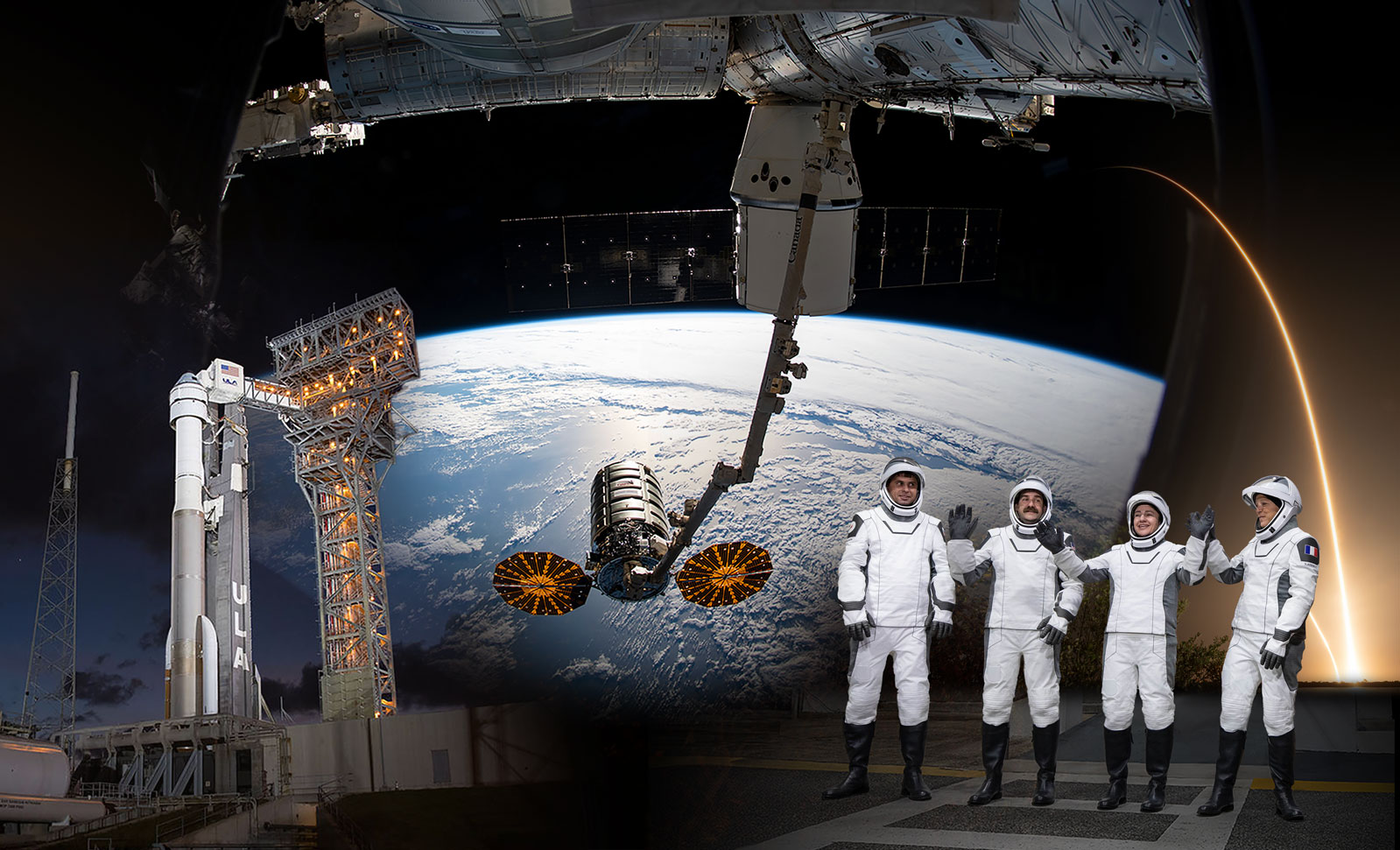
For a quarter century, humans have continuously lived and worked aboard an orbital outpost circling 250 miles above Earth. The size of a football field, the International Space Station has served as both a proving ground for cutting-edge science and a hub for commercial innovation. Together, these initiatives have fostered a rapidly growing market known as the low Earth orbit (LEO) economy.
As the Station’s 2031 decommission deadline approaches, NASA must continue to maintain safe operations while simultaneously laying the groundwork for future LEO destinations. The success of this dual mission requires robust, reliable transportation capabilities to carry supplies, science, and astronauts between Earth and the Station. NASA has contracted private U.S. companies to supply these services—but ongoing development delays and the Agency’s dependence on a single launch provider present ongoing challenges. Over the last decade, the Office of Inspector General (OIG) has made recommendations to address these hurdles, ensure astronaut safety, and maximize the Station’s final years.
NASA initially relied on the Space Shuttle and a handful of international vehicles to ferry crew and cargo to and from the Station. Leading up to the Shuttle’s final flight in 2011, the Agency shifted its transportation model to a phased commercial approach. Rather than building and operating its own spacecraft, NASA began purchasing cargo and crew flights from U.S. companies. These early efforts ultimately evolved into today’s Commercial Resupply Services (CRS) initiative and Commercial Crew Program (CCP).
NASA awarded its first cargo resupply contracts to two commercial providers in 2008, followed by a second round of CRS contracts in 2016 worth up to $14 billion. To create added redundancy in case of technical issues, the Agency procured cargo transport services from three different companies: SpaceX, Orbital ATK (later acquired by Northrop Grumman), and the Sierra Nevada Corporation (now Sierra Space).
SpaceX’s Cargo Dragon capsule has been operational since 2012 and can shuttle cargo both to and from the Station. Northrop Grumman’s Cygnus spacecraft has also been in service for over a decade, but it is an expendable, one-way freighter designed to burn up upon reentry into the atmosphere. Therefore, only Cargo Dragon can perform the critical function of returning science and research to Earth. Sierra Space’s Dream Chaser spaceplane will offer additional two-way support, but development delays have left the timeline of its maiden flight uncertain. Although Northrop Grumman is developing a new launch vehicle, at this time both Cargo Dragon and Cygnus depend on SpaceX’s Falcon 9 rocket to reach the Station.
The OIG has been monitoring the CRS program since its initial phases, noting early development delays, technical anomalies, and financial risks. In 2018, OIG auditors reviewed the second round of CRS contracts and questioned the $4.4 million that NASA had paid Sierra Space to design Dream Chaser’s additional docking approach, given that the spacecraft is still not certified for flight. Since then, multiple OIG reports have emphasized the challenges of relying on a limited pool of launch and transport providers. Currently, the OIG is examining how the Agency is managing the CRS contracts to ensure the Station receives a steady stream of science and supplies through 2030.
At the same time, NASA is working to establish and maintain reliable, U.S.-based crew transportation to the Station. After the Space Shuttle’s retirement, the Agency became solely reliant on the Russian Soyuz vehicle to carry astronauts, paying as much as $90 million a seat. In 2014, the Agency awarded CCP contracts to SpaceX and Boeing to develop alternative human spaceflight options. Those contracts now exceed $8 billion, not including the several billion dollars that NASA and the companies have invested in additional resources.
Initially, SpaceX and Boeing agreed to provide operational, human-rated vehicles by 2017. However, both providers experienced significant hardware and software challenges during development. SpaceX ultimately obtained human-rating certification for its Crew Dragon capsule in 2020, which—like Cargo Dragon—launches atop the Falcon 9 rocket.
Boeing, meanwhile, has still not obtained human-rating certification for its Starliner capsule and Atlas V launch vehicle. The company’s flight tests have revealed multiple issues, including helium leaks, propulsion system failures, and parachute anomalies. These challenges culminated in a June 2024 crewed flight test that NASA later classified as a serious mishap. What began as a roughly 10-day mission turned into a nearly 10-month stay aboard the Station after issues with Starliner delayed the astronauts’ return. The crew ultimately flew home on SpaceX’s Crew Dragon in March 2025.
In the years leading up to this crewed flight test, the OIG issued several reports outlining the challenges facing NASA and its CCP providers. These audits highlighted early funding and administrative hurdles, as well as the schedule delays that followed. In 2019, the OIG questioned $187 million in unnecessary payments to Boeing, which NASA had intended to accelerate progress and alleviate the company’s delays.
In a June 2026 report, OIG auditors determined that NASA was initially overconfident in Boeing and accepted unrealistic schedule goals. The Agency also did not exercise its limited contractual rights to access Boeing’s flight simulator training data ahead of the 2024 crewed flight test. Starliner’s next flights remain uncertain, and NASA has already spent millions of dollars accelerating SpaceX missions originally planned for Boeing. Auditors also flagged ambiguous mishap reporting requirements and workforce constraints, in addition to questioning an extra $128 million in premature payments to Boeing. With just a few years remaining before the Station’s planned decommission, NASA and Boeing have limited time to maximize the value of their significant investment in Starliner.
As the OIG has reported, the Station itself is showing signs of aging, including imminent solar array replacements and satellite repairs, as well as cracks and air leaks. Most recently, the OIG assessed the mounting risks of sustaining the Station through 2030, highlighting supply chain uncertainties, a lack of redundant crew and cargo transportation options, and the significant financial and technical hurdles of executing a safe, controlled deorbit.
NASA has been working with private industry for years to maintain a continuous human presence in LEO after the Station’s retirement. For this transition to be successful, the Agency and its partners need multiple affordable LEO transportation options to ensure safety, redundancy, and competitive pricing. Resolving today’s crew and cargo bottlenecks will ultimately fuel the thriving space economy of tomorrow.