
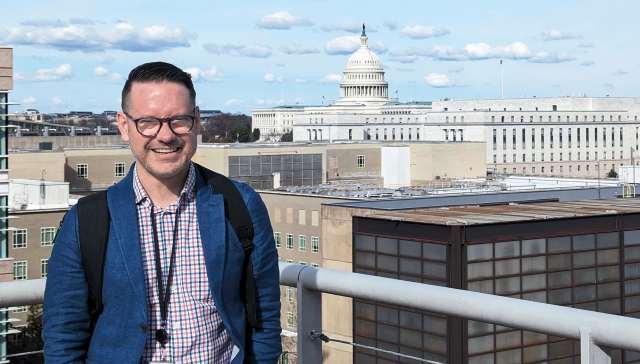






When Michael Moussalli pictured himself at NASA, he didn’t aspire to be an astronaut performing spacewalks, an engineer designing rovers, or a planetary scientist mapping distant moons. Instead, he wanted to master the business side of space exploration, ensuring ground-breaking missions are completed safely, on time, and on budget. After honing his quantitative skills as a data analytics intern at the Office of Inspector General (OIG), he became a program analyst with the Office of the Chief Financial Officer, where he manages funding for NASA payloads launching on commercial rockets.
Early on, Moussalli developed a knack for decoding charts and graphs to reveal the stories behind the numbers. After taking statistics in high school, he became fascinated by financial analysts who mine historical data to predict future trends and make real-time business decisions. He decided to apply to Auburn University and pursue the school’s brand-new business analytics major.
After graduating in 2018 with his bachelor’s degree, Moussalli began his first job at Regions Bank. He completed the bank’s two-year Finance Development Program, exploring several different specialties before transitioning to the Corporate Banking Group focused on strategic planning and financial forecasting. He then joined a startup called Shipt, where he engineered data models to streamline financial reporting and helped executives determine projected revenue and expenses.
In 2022, Moussalli returned to Auburn University to earn a dual Master of Business Administration and Master of Finance while working as a graduate teaching and research assistant. The program spanned two years, and students were required to complete an internship over the summer break. Moussalli had always wanted to work at NASA, which motivated him to scour the Office of STEM Engagement webpage and apply to a 10-week internship with the OIG’s Office of Data Analytics (ODA).
“The OIG’s mission is to help the Agency achieve its full potential by ensuring things are done efficiently and effectively,” Moussalli said. “ODA supports this goal by building advanced audit and investigative tools that translate complex data into powerful insights.”
At the direction of the Chief of ODA, Moussalli leveraged Excel and the data analytics tool Power BI to prioritize projects and quantify how each ODA member allocated their time.
One of his favorite parts was developing graphs, charts, and data visualization dashboards to highlight patterns and tell a story. “Data visualizations are extremely important because they help you communicate your findings and see things from a big-picture perspective,” he explained.
Once he’d created a framework to track the team’s priorities, the next step was automating the process by using Visual Basic for Applications to design a macro—a custom script that automatically handled data input. This meant he could instantly view the up-to-date project plan with the click of a button.
Although Moussalli was based at Marshall Space Flight Center in Huntsville, Alabama, he had the chance to connect with OIG trainees from other NASA centers during a one-week trip to Washington, DC. His cohort visited Headquarters, toured Goddard Space Flight Center, and attended multiple career development activities. He also teamed up with a fellow ODA intern to co-author a handbook detailing the critical role data analysts play in the auditing process.
“It was one of the best summers of my life,” Moussalli said. “If it weren’t for that internship, I wouldn’t be where I am today. I’d applied to multiple NASA positions over the years, but doors really started to open once I added the OIG to my resume.”
After completing his master’s program in 2024, Moussalli secured his current role with NASA’s Office of the Chief Financial Officer. As a program analyst for the Launch Services Program, he tracks funding for agency missions flying on commercial rockets. Much like the OIG, he works to ensure government dollars are spent efficiently and in accordance with mission milestones.
His path to NASA was years in the making, but stepping into this full-time role was worth the wait.
“My advice to prospective interns is to be patient,” he said. “It may take some time to land your dream job, but don’t give up. Be willing to learn as you go and always have a good attitude.”
Above all, stay curious. “Being a data analyst is all about asking the next question,” he explained, “and the same applies to anyone just starting their career—keep pushing and you’ll find the next great thing.”