


On July 20, 1969, Apollo 11 Commander Neil Armstrong became the first human to set foot on the Moon. Exactly 33 years later—on July 20, 2002—undercover agents from the NASA Office of Inspector General (OIG) and Federal Bureau of Investigation (FBI) apprehended a group of interns who’d plundered $21 million worth of Moon rock samples from this and every Apollo mission since.
Each NASA employee, trainee, and contractor is expected to uphold a strict code of ethics that preserves public trust. When this trust is broken and the Agency’s integrity is compromised, the OIG’s Office of Investigations steps in. Over the last decade, OIG investigators have initiated hundreds of cases related to ethics violations, resulting in over $4 million in monetary impact. These ethical breaches can take many forms: officials who accept bribes, contractors who offer kickbacks in exchange for favorable treatment, civil servants who leverage their positions for personal gain, or—in this case—interns who steal precious Moon rocks.
In June of 2002, OIG agents at Kennedy Space Center received a tip from the FBI about a man called Orb Robinson who was selling lunar samples for $1,000 to $5,000 a gram. Orb had posted an advertisement on the Mineralogy Club of Antwerp website and was emailing a Belgian rock collector. The rock collector became suspicious and contacted authorities. Posing as the rock collector’s U.S. relatives, the agents began emailing Orb to negotiate the quantity and price. They made plans to meet him on July 20 at an Italian restaurant in Orlando, Florida, to finalize the sale.
As investigators later determined, Orb Robinson was actually Thad Roberts, an intern at Johnson Space Center (JSC). While the agents prepared their covert operation, Roberts and his friends were plotting their audacious heist to procure the lunar samples they’d promised.
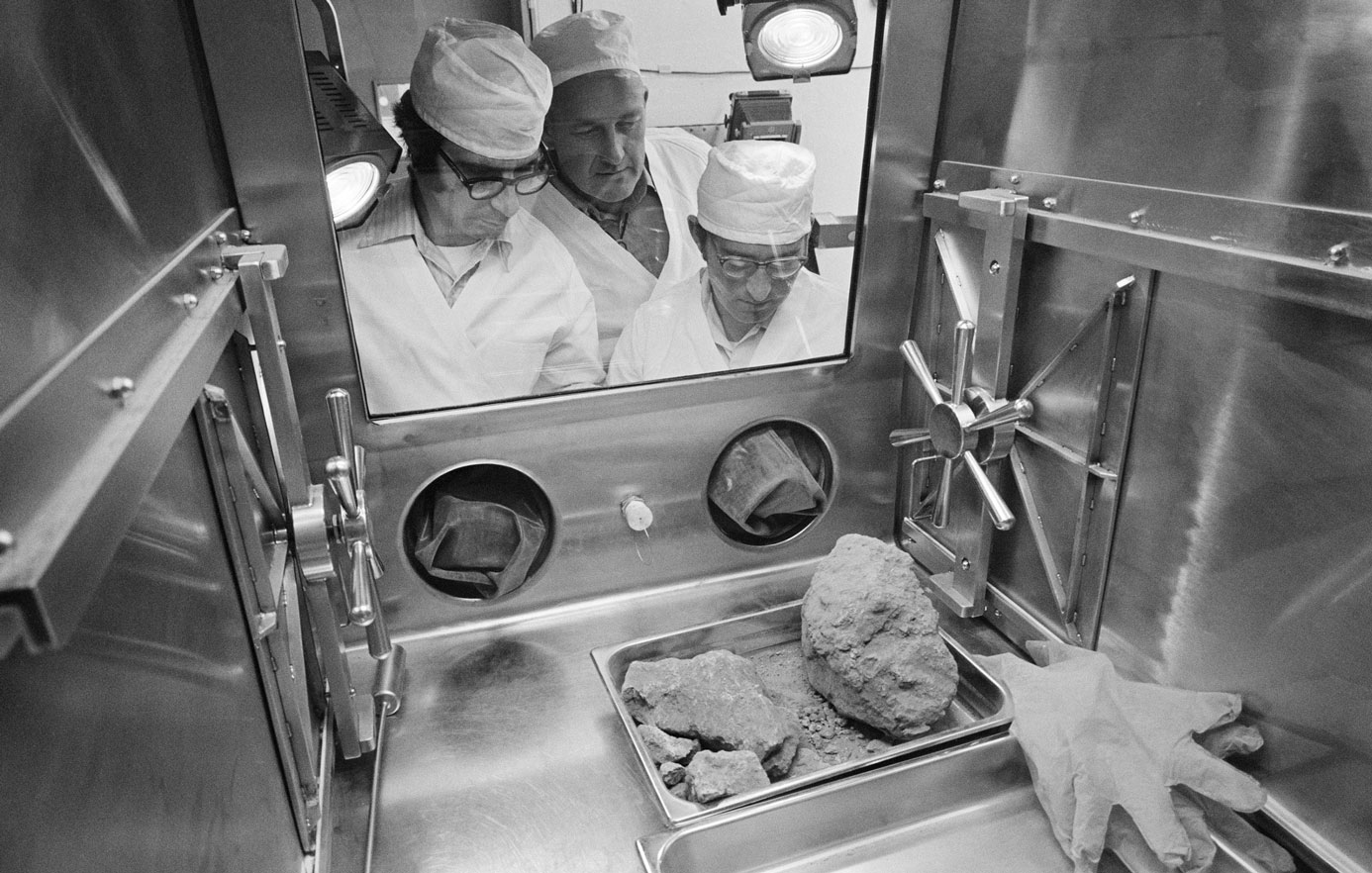
On the night of Saturday, July 13, Roberts and two fellow interns, Tiffany Fowler and Shae Saur, used their NASA IDs to enter the JSC campus. They snuck into the lab of scientist Everett Gibson and absconded with a 600-pound safe. Their loot included Moon rocks from every Apollo lunar landing, a Martian meteorite, and three decades of Gibson’s handwritten research notes.
On Monday, July 15, Gibson reported his safe was missing. Two days later, Roberts (still posing as Orb) provided sample numbers to the undercover agents, which matched the sample numbers listed on Gibson’s inventory. Although the agents still didn’t know Roberts’s true identity, they were able to trace the trail of digital evidence from his emails back to servers at JSC and the University of Utah, where he was a student.
On July 20, the undercover agents met Roberts, Fowler, and another co-conspirator (a friend of Roberts named Gordon McWhorter) at the restaurant in Orlando. There, Roberts finally divulged his real name. The investigators returned with the suspects to their hotel to retrieve the rocks and arrested the thieves in the parking lot. Saur was arrested that same day in Houston, Texas.
Investigators ultimately recovered the stolen samples—but not before the suspects had contaminated them, rendering them virtually useless to the scientific community.
Roberts, Fowler, Saur, and McWhorter were all charged with conspiracy to commit theft and interstate transportation of stolen property. In the process, Roberts also admitted to stealing dinosaur bones from a museum in Utah. He served just over 6 years of his original 8-year prison sentence and was released in 2008.
“NASA’s mission depends on a workforce that embodies the highest ethical standards,” said Michael Graham, NASA OIG’s Deputy Assistant Inspector General for Investigations. “Because ethics violations undermine public trust and the Agency’s critical work, we are committed to investigating misconduct, holding individuals accountable, and protecting the integrity of NASA.”
Although most ethics violations are not elaborate Moon rock capers, each offense erodes public trust and threatens NASA’s mission. No matter the scale of the transgression, OIG investigators are there to preserve the Agency’s legacy—from the first Moon landing to the next.
If you suspect fraud or misconduct at NASA or its programs, contact OIG investigators via the hotline.