



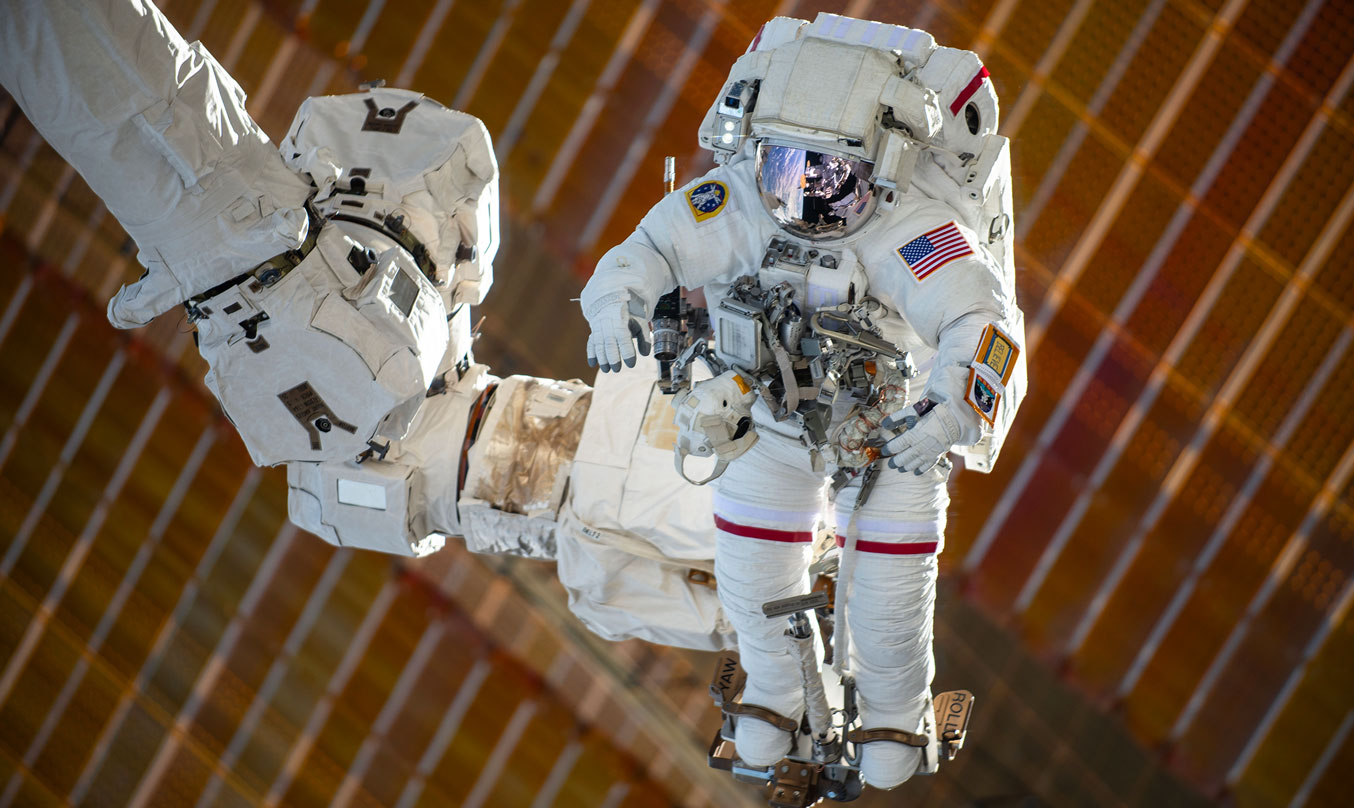
Imagine exploring the cosmos in your own personal spacecraft with oxygen to breathe, water to drink, waste management, cooling, ventilation, and health monitoring. NASA astronauts wear puffy, white spacesuits that offer these functions and more when they perform spacewalks outside the International Space Station (ISS).
Since the 1970s when they were initially designed, these Extravehicular Mobility Unit (EMU) spacesuits have been updated and refurbished several times. However, they have far exceeded their intended 15-year design life. Today, their advanced age is causing difficulties as NASA races to develop next-generation spacesuits to replace them. In the meantime, the Agency must ensure astronauts can continue to safely perform spacewalks until the ISS’s planned decommission in 2030.
Over the last decade, the Office of Inspector General (OIG) has noted a myriad of design inadequacies, health risks, and inventory issues associated with sustaining the EMUs. On two occasions, NASA suspended ISS spacewalks because an EMU helmet was accumulating water—impairing vision and increasing the chance of asphyxiation. In another instance, a spacewalk was canceled because there was a leak in the service and cooling umbilical unit that provides water, power, and oxygen to the EMU. Astronauts have also reported injuries due to the bulky spacesuit design and physical demands of performing spacewalks.
NASA is solely reliant on one provider, Collins Aerospace, to ensure that these EMUs remain safe and functional. As of July 2025, Collins’ contract was valued at $1.5 billion and had been extended through 2027. If NASA extends it again through 2030, the Agency will pay Collins a total of $1.8 billion.
In a recent report, the OIG determined that Collins’ performance had declined over the past several years, leading to considerable schedule delays and cost overruns. To complicate matters further, the EMU’s design is so old that some historical suppliers have gone out of business or stopped producing the necessary parts. Between Collins’ mismanagement and these supply chain issues, critical EMU components have not been replaced or maintained as needed.
The Agency has struggled to motivate Collins to improve performance, in part because there are no alternative contactors to support the EMUs. In March 2023, NASA sent a letter to Collins’ senior leadership expressing strong dissatisfaction with how the company was managing multiple contracts. Despite these issues, NASA continues to give Collins high ratings for its performance, resulting in inflated monetary payments called award fees. The most recent OIG spacesuit audit questioned all the award fees that NASA has paid to Collins over the last five fiscal years. The report also recommended that the Agency improve accountability by adjusting Collins’ award fee plan to include up-to-date requirements and clear, objective performance criteria. In response, the Agency agreed to make the plan clearer and evaluate the feasibility of updating the requirement language.
Given these ongoing issues, NASA has been working for over a decade to develop new spacesuits that will replace the aging EMUs aboard the ISS. Astronauts will also wear these next-generation suits during the Artemis III mission, which will return humans to the Moon for the first time since the Apollo Program.
In 2017, the OIG reported that NASA had spent nearly $200 million on this new technology, despite being years away from finishing the first suit. By the time the OIG issued another spacesuit audit in 2021, this initiative was still lagging behind schedule and had cost the Agency over $400 million. In an upcoming report, the OIG will review how these efforts have continued to progress.
Spacesuits are critical to NASA’s ambitious goals of returning humans to the Moon and exploring Mars. Without well-maintained, reliable suits, astronauts cannot operate safely in the extreme environments outside their spacecraft. Failure to address current shortcomings could elevate costs and risk schedule delays, jeopardizing ISS operability and the lives of those aboard.